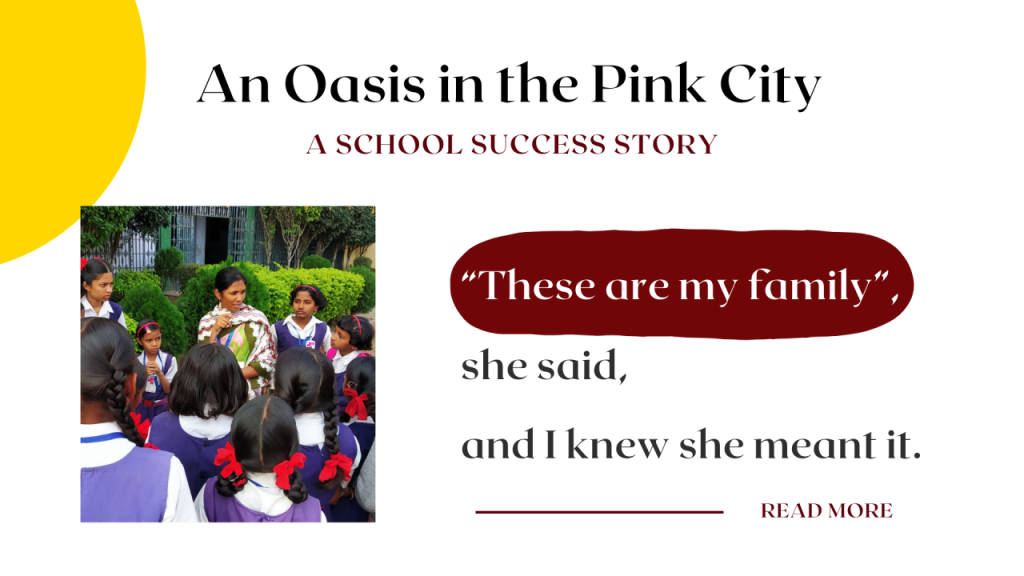
“An Oasis in the Pink City” is a school success story that is all heart. Read on to learn about a principal who demonstrates robust, adaptive & empathetic leadership by empowering her school community.
In almost 5 years of working across 13 states (today 25 states), this is the best state school I have visited. Some of its practices are good by international standards. Much of its success is down to its visionary principal, and the way in which she has empowered her students and teachers.
Because I have never been one for keeping a diary, the only dusty attics I end up rummaging through are the ones inside my head or more securely the ones at the tips of my fingers. Today, most of my memories are recorded on hard drives, saved in random files and folders, even downloaded from now-discarded computers. While it isn’t as romantic as leafing through the faded pages of an old diary, the richness of the memories is just as potent. They are made more precious because I am rediscovering them as if for the first time.
In today’s post, ‘An Oasis in the Pink City’ I am going to allow myself the luxury of sharing a monthly longer, more reflective piece. Since we are currently working with the Nagaland State government on a World Bank project to improve the governance and leadership capacity of the state and its 2000 schools, I thought I would begin with a visit to a government school.
To set this recollection into the context of school review, I have highlighted 3 Leadership and Management standards from Adhyayan’s Collaborative review diagnostic which are clearly evidenced in this lovely school.
I found ‘An Oasis in the Pink City’ in a folder titled ‘COVID Diaries’.
An Oasis in the Pink City
Today I visited a Rajasthan government upper secondary school, and I met its principal. As we reached the school, she was waiting for us on the steps of her school surrounded by her students. While the welcome on the steps of the school was ritual, her warmth and the delighted smiles of her students spoke of a school rich in relationships. The school educates 1200 girls between the ages of fifteen and eighteen, most of whom belonged to a craft community. Not long before we visited the school, all her students had gone on a 3-day ‘strike out’. Their beloved principal had been transferred to another school and they didn’t want her to leave. Thanks to them, today when we visited, she was still where she belonged. (L&M 1b: The principal and other leaders are interested in what students are learning and talk with and listen to them around the school)
Her school is in the walled city of Jaipur in Rajasthan. The maze of the old city is filled with people and littered with their detritus, until that is, you stepped off the street into an oasis of order and calm. The school’s small courtyard is framed by young trees planted amongst the paving and defined by a centerpiece of potted greenery. Beyond the plants, on a raised stage was a group of 10-year-old girls sat studying, absorbed.
The paving was still drying when we arrived, the classrooms and public areas were dust and litter-free, and it was obviously not just because we were visiting. The shoes neatly, almost geometrically, placed outside the classroom doorways led us to eager smiles inside. The classrooms spoke of a dedication to teaching and learning of girls and teachers alike! (L&M 7a: The school’s grounds, reception area, corridor, and classrooms make the students and staff proud of their surroundings)
The affection and respect shown by the girls to their teachers were matched by high expectations of teaching and student endeavour. The Science being taught to groups of Standard 11 girls in the most rudimentary, yet pristine conditions, was comparable with UK standards. And yet this school single-mindedly serves a very poor craft community. While she faced the constant challenge of her girls leaving early to marry, the school contextualised their learning by including examples of their traditional craft in science and mathematics lessons and encouraging their entrepreneurial abilities. In fact, during our visit, two of the girls showed their prowess by applying a quick henna design on the hands of an amazed member of our team! (L&M 7b: The school’s inclusion policy ensures that students who have particular learning or social difficulties feel confident and are well supported)
In almost 5 years of working across 13 states (today 25 states), this is the best state school I have visited. Some of its practices are good by international standards. Much of its success is down to its visionary principal, and the way in which she has empowered her students and teachers.
While it is true that she has created an ordered culture driven by accountability and passion, it is, in my view, her ability to liberate her staff and students to take on leadership roles that makes her so effective. My final image of her is of her senior team and colleagues who run the elementary and secondary sections with their arms around each other posing for the inevitable photos, but for themselves not just for us. “These are my family”, she said, and I knew she meant it, but I also knew that this matriarch would accept nothing but absolute commitment to her children.
11 years on, the images of that school remain imprinted in my memory with the clarity and richness of its home, ‘The Pink City’.