
Which is the handle that is turned least often by schoolleaders? That’s right. It’s the one attached to the classroom door.
It’s 3 pm on a Thursday afternoon. Around the table sits a school’s instructional leadership. The Standing Agenda item they are discussing is the week’s classroom evidence. On the screen is a Google Sheet displaying the data of the Classroom Learning Walks taken by the team. In a set of bar and pie charts are revealed last week’s data of the team’s daily 7-10 minute classroom walks. It includes data on the starts and endings of classes, the evidence of essential instructional agreements, as well as the lesson’s learning objectives. While it will sometimes highlight the practice of a teacher that needs to be shared or supported which can then be addressed through developmental lesson observations, the classroom walk is a powerful management tool for identifying and tracking trends of student progress, instructional skills and the learning environment. After today’s meeting, they will be congratulating the teachers on their prompt, focused starts to most lessons during this last week and sharing with them that the particular focus of the coming week’s classroom learning walks will be of the teachers’ deployment of peer learning.
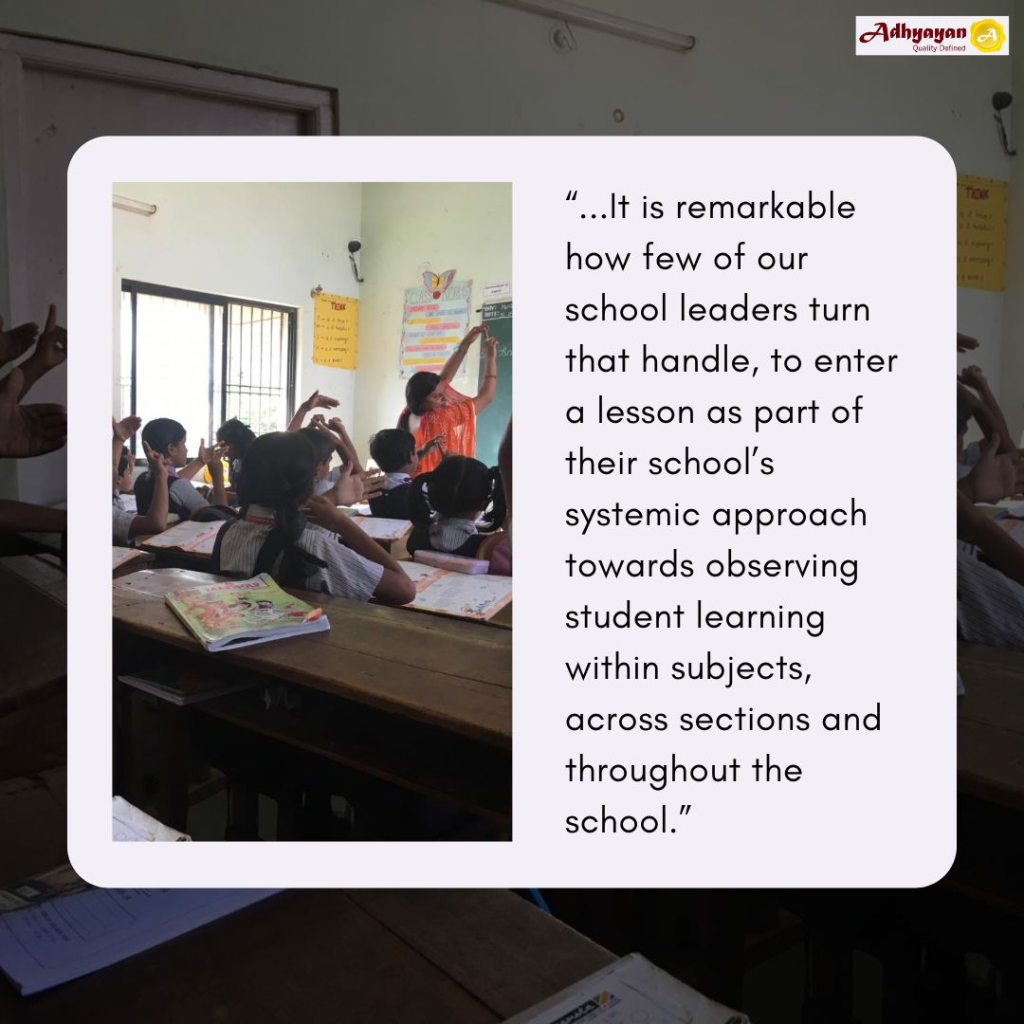
So, given that the classroom can be the source of so much learning, it is remarkable how few of our school leaders turn that handle, to enter a lesson as part of their school’s systemic approach towards observing student learning within subjects, across sections and throughout the school. Unsurprisingly and possibly of greater concern, the picture is similar across many school networks.
I vividly remember sitting down well over a decade ago now in Lucknow, with Professor Geeta Kingdon, Chair of Education and International Development at the Institute of Education, University College, London University and President of City Montessori School, listening to her reflections on the importance of evidence-based policy decision making, to schools as well as to government. Her insights founded on her research, and as an advisor to government and donor agencies internationally and within India, struck a chord with me since all our work in Adhyayan endeavours to enable leaders and their school communities to collect evidence through collaborative review as the first step in planning their priorities for school improvement and the consequent teacher development.